EVIAS Dynamic Fast Charging E-DFS1®

Service Cloud
real time connections with service center for monitoring and data analysis

Externalized Charging System
Externalization of the charger further simplified the set up on the vehicles

Control Unit
in-vehicle touch screen human machine interface

Charging Collector
under-vehicle automatic fast charging collector for both dynamic and static charging
Conductive eRoad
in-road conductive rails and charging system
EVIAS Static Fast Charging E-SFS1®
The CCS2 charging standard protocol is used when the vehicle is parked.
Charging Collector
under-vehicle automatic fast charging collector for both dynamic and static charging
How does it work?
1
A GPS-equipped sensor system detects the electric track; Dynamic connector automatically deploys into the track.
2
The track supplies energy directly to the electric motor and simultaneously charging the battery. The energy supply can last up to 5x km driven!
3
When the vehicle is overtaking or reaches the end of an electrified section, the connector automatically raises into a folded position.

We are moving towards
2000kW
Current EVIAS
Charging Solution
1000kW
Industry average
Charing Solution
350kW
We move beyond Level 3 Fast Charging and not stopping there.
It’s future-proofed.
Today’s EV fast charging at Level 3 is ranging from 60kW to 350 kW, will soon be insufficient and requiring upgrade of charging facilities. By externalizing the charging system from the vehicle and road, EVIAS solution enables charging support up to 1MW (1000kW), with further progression to 2MW on the horizon.
Seamless Upgrade:
No total changeover required EVIAS solution ensures future-proofing without the need for a complete overhaul of the charging infrastructure. Adapt to the evolving demands of the electric vehicle industry easily.
It’s Safe as your Home Plug
412
Test runs with charging from the road system
604
Total number of test runs
824
[km] Distance driven with charging from the road system
1208
[km] distance driven with the pilot eclectic truck
Thoroughly Tested
Obstacles
Radar discovery with collision allowance

Water
Designed to channel rain water out of the track

Snow & Ice
Can be equipped with electrical heating

Sand & Dirt
Patented device to clean the track

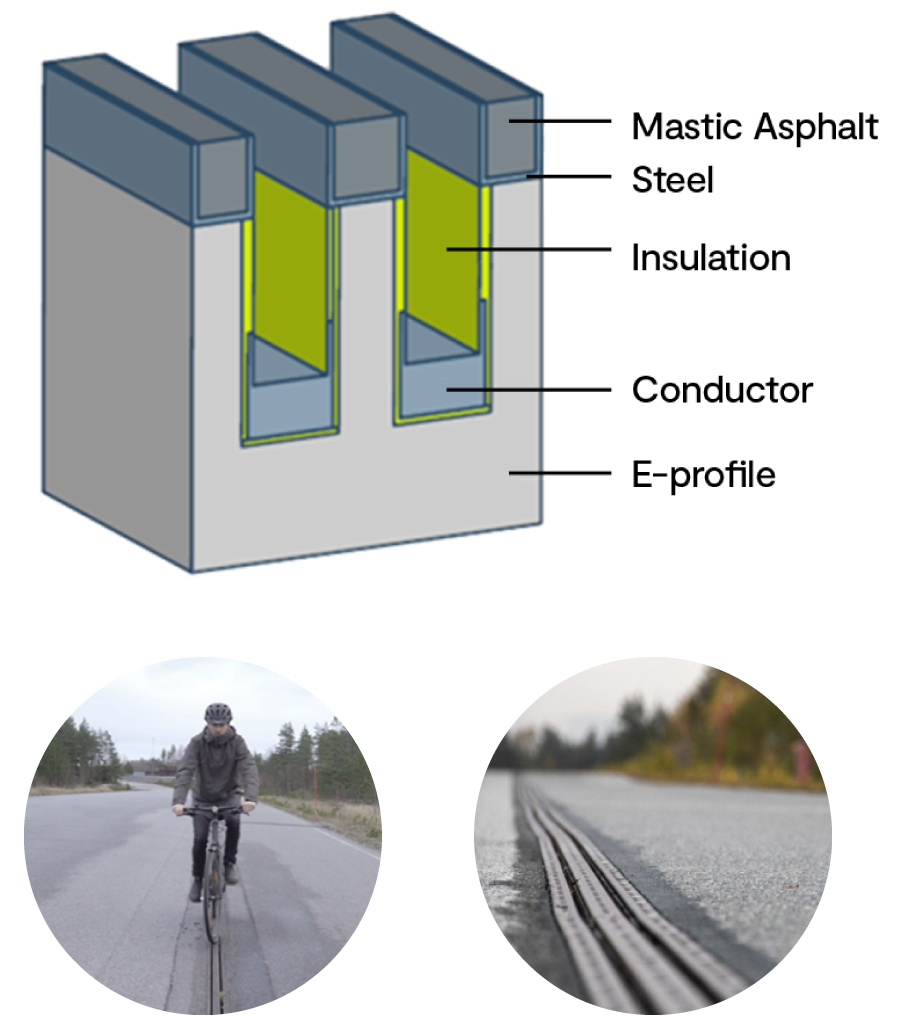
IP20 Safety Standards
The conductive rails meet IP2 safety standards which is as safe as your home plug.
Upper part of the track is electrically grounded, while the conductor is situated deep inside a trench below the road surface, which is only 11mm wide. Even fingers and the thinnest racing bike wheels (19mm) cannot slip into the track.
Track segments are energized only briefly as vehicles pass for charging.
When vehicle charging is inactive, the electric voltage is minimal (<1V), posing no harm to humans or animals, even when the trench is filled with conducting salt water.